
If you are considering dental implant treatment in Bangkok, whether you live here or are travelling for it, the hardest part to picture is not the surgery. It is the sequence: what happens first, what has to heal before the next step can begin, and how much of it can reasonably fit into one stay. This article follows that sequence, from the first consultation to the final crown. It does not set out what a dental implant is, which is covered separately. It sets out what the treatment asks of you.
Consultation and three dimensional imaging
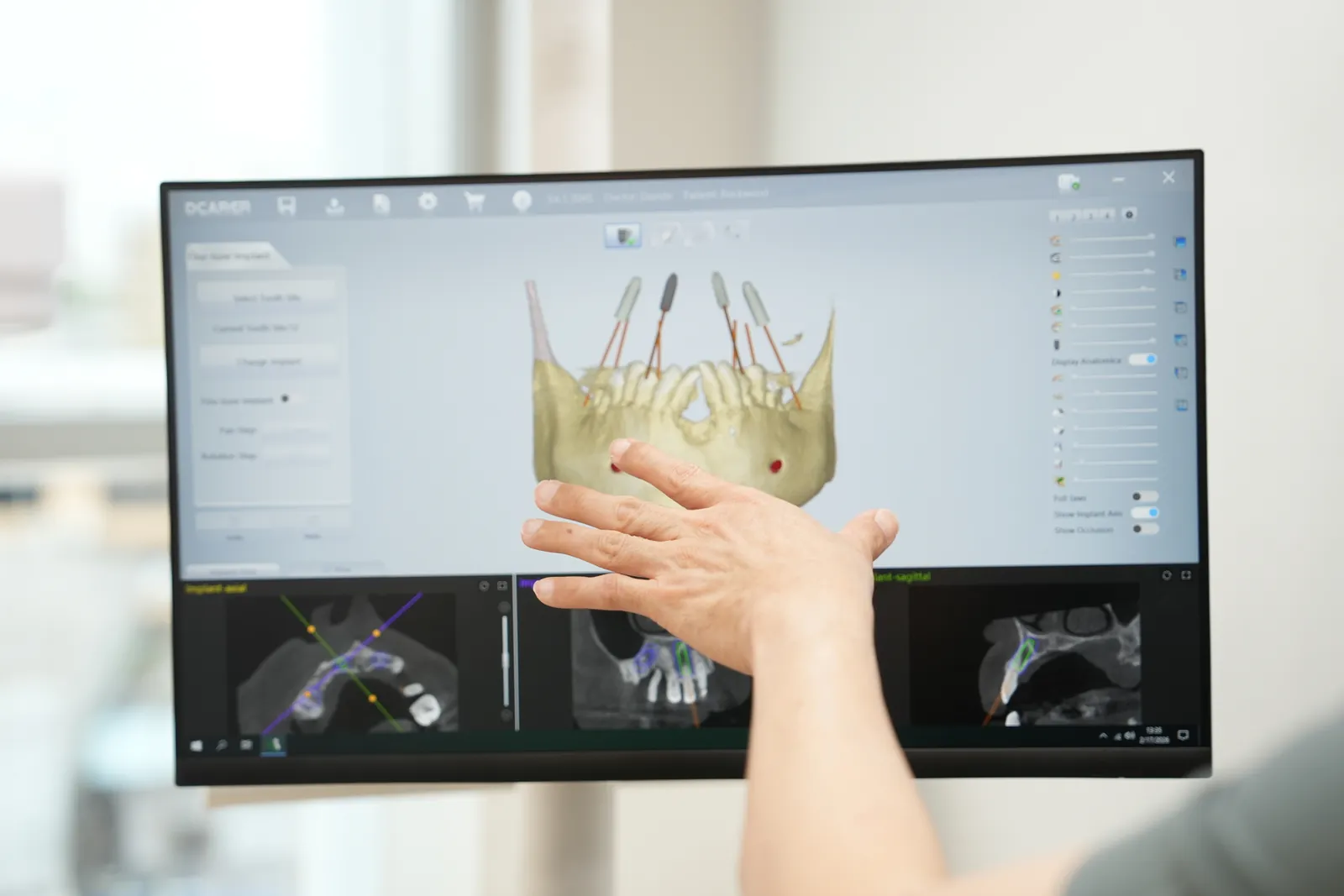
Treatment starts with an examination and a three dimensional scan. An ordinary dental X-ray is flat. A CBCT scan shows the jaw as a volume, which is what lets the dentist judge whether there is enough bone in the exact position an implant needs, and see the structures that have to be avoided. It is also what makes planning possible before anyone operates: the implant position is decided on screen first, and the surgery follows that plan rather than discovering the anatomy along the way.
For a patient coming from abroad, this step decides everything that follows. Until the scan has been read, nobody can tell you honestly how many stages your case needs. A plan offered before it is a guess, however confident it sounds.
Preparing the site
Not every mouth is ready to receive an implant on the day it is examined. Two things commonly come first.
- A tooth that cannot be saved has to come out. Extraction leaves a socket that changes shape as it heals. In some cases the implant is placed at the same appointment; in others the site is left to settle first.
- Where the bone is too narrow or too short to hold an implant, it is rebuilt. Bone grafting and sinus lifts add the volume that is missing. Sometimes this happens during the implant surgery itself; sometimes it is a separate procedure that has to mature before implants can follow.
Bone loss is the usual reason a straightforward case becomes a longer one. It begins once a tooth is lost, because the bone no longer receives the forces of chewing. A gap that has been left for years is more likely to need grafting than a recent one, which is worth knowing before you assume your case is simple.
Placing the implant
The implant is placed under local anesthesia. The dentist opens the gum over the planned position, prepares the bone and seats the titanium post, then closes the gum over or around it depending on the plan. Swelling and tenderness in the days that follow are expected and settle.
In suitable cases the implant and a temporary crown can be completed within the same day, which is possible here because the scanner and the laboratory are both on site. Whether your case qualifies is a clinical judgement made after the scan, not a package you can book in advance: same-day implants explains what makes it possible.
Osseointegration, the part that cannot be hurried
Once placed, the implant is left while bone grows onto its surface and locks it in position. This is called osseointegration, and it takes months. It is not a delay that can be shortened by paying more or by choosing a different clinic. It is biology, and the final restoration is fitted only once that bond is established.
A temporary crown or bridge is often fitted in the meantime so that you can eat and speak normally. It is there for function and appearance while healing runs its course, not to carry a heavy load.
The final restoration
When the implant is stable, the tooth on top is made. An abutment connects the implant to the restoration, and an impression or a digital scan records its position, the shape of the gum around it and the way your teeth meet. The laboratory then makes the crown, or a bridge where several teeth are being replaced. Materials and fitting follow the same principles as conventional crowns and bridges.
For a full arch the sequence is the same, but the restoration is a fixed bridge carried by several implants rather than a single crown. Full-mouth implants covers that case in its own right.
Follow-up, and what actually loses implants
An implant cannot decay, but the gum and bone around it can become inflamed if plaque is allowed to build up, and that is what loses implants. Cleaning between the teeth matters as much as brushing. Reviews check the fit of the restoration, the health of the tissue around the implant and, where indicated, the bone level on an X-ray. If you are treated in Bangkok and live elsewhere, settle before you leave who will carry out those checks.
Planning the treatment around your visits
The honest summary for an international patient is this: the surgery is short, the healing is not, and no clinic can compress the integration period. A plan that includes bone grafting, or a healing phase before the final tooth is fitted, cannot be completed in a single trip.
What can usually be grouped into one stay is the assessment, the imaging, any preparatory surgery and the implant placement, with the final restoration on a later visit. Three things are worth settling before you book anything: how many stays your plan needs, what you leave with at the end of each one so that you are never without teeth in between, and what happens if something needs adjusting once you are home.
What makes a case simple or complex
Two patients missing the same tooth can need very different treatment. The factors that usually decide are these.
- How much bone is left, and its quality. This is the most common reason a plan grows.
- Where the tooth sits. A front tooth is judged on appearance as well as function, and the gum line around it has to be right.
- How many teeth are missing, and whether they sit next to each other.
- The health of the gums. Active gum disease is treated before implants are placed, since the inflammation that loosens natural teeth threatens implants too.
- General health and habits. Smoking and poorly controlled diabetes both affect healing, and your dentist will ask about them.
These are questions for the consultation. The clinic does publish its price list, but the figures there are indicative: yours is settled once an examination has shown what your case needs. If you are still weighing whether implants are the right answer for you at all, rather than how they are done, an overview of who implants suit is the better starting point.
Read more about this treatment: Types of dental implants